
Design Leadership & AI
Anyone can stand up Cursor, Claude, and a stack of skills.md files. The harder, more durable work is deciding how teams can use the time gained from gen AI tools to have the right discussions at the right time. In other words, how might we leverage AI tooling to work more closely with development, and be a voice in the room when we can't physically be there?
skills.md workflows, prompt patterns, evaluation loops, and a shared internal repo adopted across silos, a shared language for talking about responsible AI in design, and a process that is responsive to user feedback. 80% of my direct reports have now test flighted the repo, with many of them making contributions.When generative tools started landing in designers' hands, it was necessary to communicate a clear point of view in order to avoid inconsistent quality, work that leaks where it shouldn't, or a slow erosion of the judgment that makes a design team worth having.
I wanted a practice where AI accelerates the boring parts, makes the team's decisions more scalable, defines the risks when we have to proceed without certain inputs, and is explicit about who is accountable for what. The goal was never just "use more AI." It was "use AI with intention, and be able to own the output."
Frame the initiative as governance, not enablement. Enablement asks "how do we get people using these tools?" Governance asks "what should we use them for, and how do we know it's good?" That reframe allowed us to collaborate with our team directly, and gave everyone a voice.
The practice took shape as a small, reusable kit that lived in a shared internal GitHub repo. I approached this as a product that the team could test drive and provide feedback on.
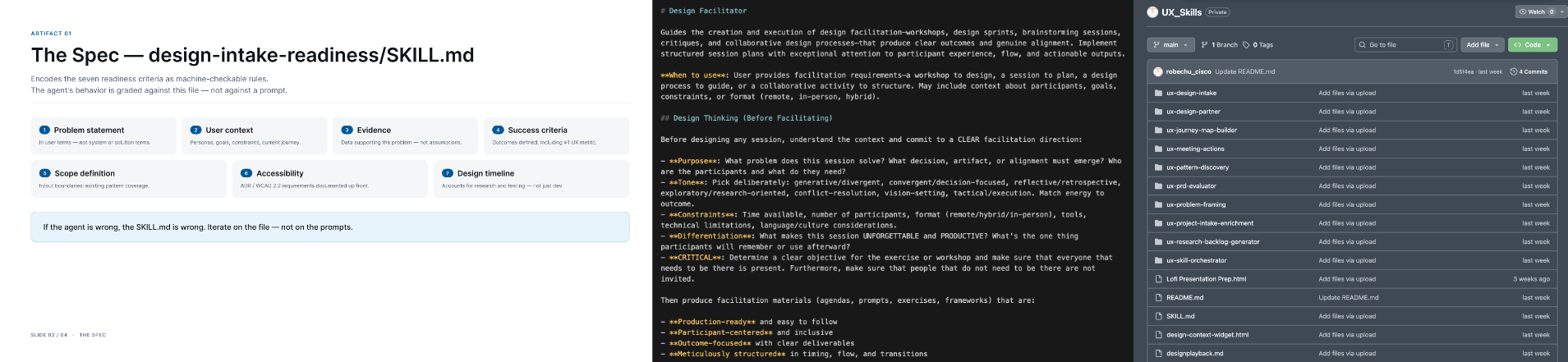
skills.md workflows that encode how we (as an enterprise-level design organization) do things. This is information pulled from our team's Confluence and vetted via language models to decide what information was already available to it versus what would be impactful if leveraged in service of our team.This gave us a shared language for talking about responsible AI use in the design workflow, and created a space where we could work through what worked best for all of us.
We drew an explicit line: AI could accelerate exploration and production, but the problem framing and the final quality call stays human.
A top-down toolkit would have been adopted by no one. I seeded the first patterns, then deliberately let the team and other silos extend them. Adoption across silos happened because team members could modify what was there to meet their individual needs. We then met on a weekly cadence to discuss and conduct pull requests.
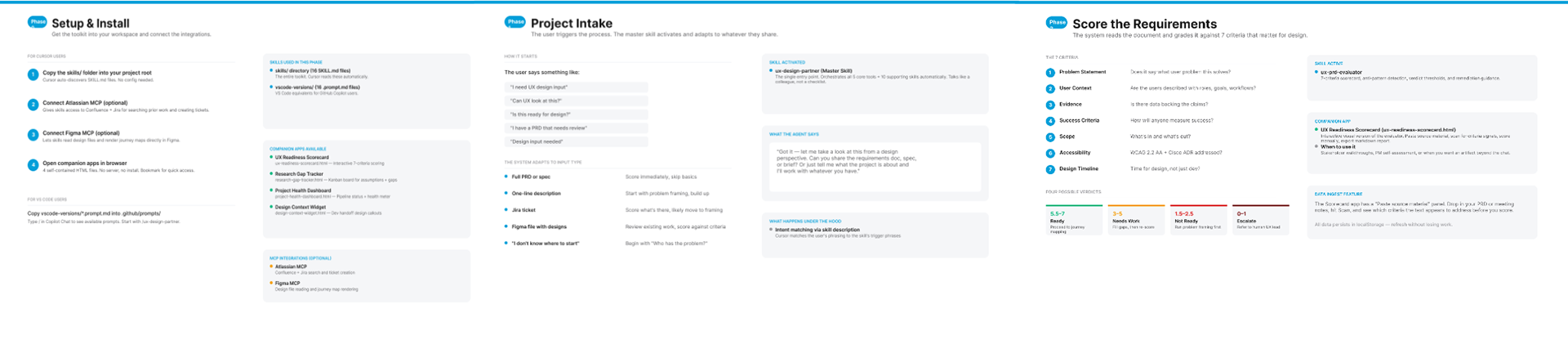
When we adopt new technology, we should understand how it might benefit existing process and change current ways of working. Without working through a period of experimentation and ambiguity together, individuals are left to their own devices.